|
President Bill Clinton has come
out in favor of the registration of all law-abiding American gun owners.
"People ought to have to register guns like they register their cars,"
he said.1 Already, the Clinton-Gore administration
is misusing the national instant check system to retain the identities of
firearms purchasers. Government records on gun owners supposedly protect
society.
It would be instructive at this
time to recall why the American citizenry and Congress have historically opposed
the registration of firearms. The reason is plain. Registration makes it easy
for a tyrannical government to confiscate firearms and make prey of its
subjects. Denying this historical fact is no more justified than denying that
the Holocaust occurred or that the Nazis murdered millions of unarmed people.
I am writing a book on Nazi
policies and practices that sought to repress civilian gun ownership and
eradicate gun owners in Germany and occupied Europe. The following sampling of
my findings should give pause to the suggestion that draconian punishment of
citizens for keeping firearms is necessarily a social good.
The Night of the Broken Glass (Kristallnacht)--the
infamous Nazi rampage against Germany's Jews--took place in November 1938. It
was preceded by the confiscation of firearms from the Jewish victims. On Nov. 8,
The New York Times reported from Berlin, "Berlin Police Head Announces
'Disarming' of Jews," explaining:
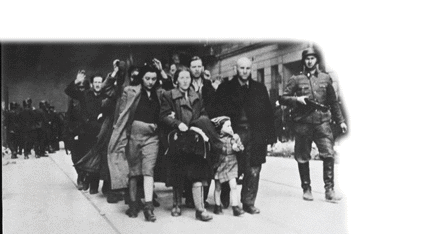
After invading, Nazis used pre-war lists of gun owners to confiscate
firearms and many gun owners simply disappeared. Following confiscation,
the Nazis were free to wreak their evil on the disarmed populace, such as
on these helpless Jews from the Warsaw Ghetto.
"The Berlin Police President,
Count Wolf Heinrich von Helldorf, announced that as a result of a police
activity in the last few weeks the entire Jewish population of Berlin had been
'disarmed' with the confiscation of 2,569 hand weapons, 1,702 firearms and
20,000 rounds of ammunition. Any Jews still found in possession of weapons
without valid licenses are threatened with the severest punishment."2
On the evening of Nov. 9,
Adolph Hitler, Propaganda Minister Joseph Goebbels and other Nazi chiefs planned
the attack. Orders went out to Nazi security forces: "All Jewish stores are
to be destroyed immediately . Jewish synagogues are to be set on fire . The Führer
wishes that the police does not intervene. All Jews are to be disarmed. In the
event of resistance they are to be shot immediately."3
All hell broke loose on Nov.
10: "Nazis Smash, Loot and Burn Jewish Shops and Temples," a headline
read. "One of the first legal measures issued was an order by Heinrich
Himmler, commander of all German police, forbidding Jews to possess any weapons
whatever and imposing a penalty of twenty years confinement in a concentration
camp upon every Jew found in possession of a weapon hereafter."4
Thousands of Jews were taken away.
Searches of Jewish homes were
calculated to seize firearms and assets and to arrest adult males. The American
Consulate in Stuttgart was flooded with Jews begging for visas: "Men in
whose homes old, rusty revolvers had been found during the last few days cried
aloud that they did not dare ever again return to their places of residence or
business. In fact, it was a mass of seething, panic-stricken humanity."5
Himmler, head of the Nazi
terror police, would become an architect of the Holocaust, which consumed 6
million Jews. It was self-evident that the Jews must be disarmed before the
extermination could begin.
Finding out which Jews had
firearms was not too difficult. The liberal Weimar Republic passed a Firearm Law
in 1928 requiring extensive police records on gun owners. Hitler signed a
further gun control law in early 1938.
Other European countries also
had laws requiring police records to be kept on persons who possessed firearms.
When the Nazis took over Czechoslovakia and Poland in 1939, it was a simple
matter to identify gun owners. Many of them disappeared in the middle of the
night along with political opponents.
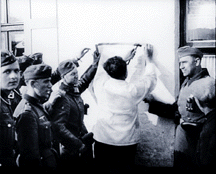
Invading troops in
Holland in 1940 immediately nail up posters announcing a ban on all
firearms.
From Die Deutsche Wochenschau, May 15, 1940.
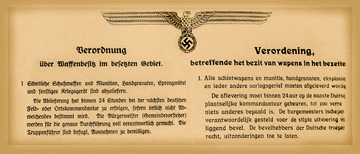
Closeup of the Holland
poster banning guns. Citizens had 24 hours to surrender all firearms to
the Nazis or face the death penalty. Printed in German on the left and
Flemish on the right. For translation, see sidebar. From Die Deutsche
Wochenschau, May 15, 1940.
Regulations on
Arms Possession
in the Occupied Zone
1. All firearms and
ammunition, hand grenades, explosive devices and other war
materiel are to be surrendered.
.....The delivery
must take place within 24 hours at the nearest German military
administrative headquarters or garrison, provided that other
special arrangements have not been made. The mayors (heads of the
district councils) must accept full responsibility for complete
implementation. Commanding officers are authorized to approve
exceptions.
|
Imagine that you are sitting in a movie house in Germany in May 1940. The German
Weekly Newsreel comes on to show you the attack on Holland, Belgium and France.
The minute Wehrmacht troops and tanks cross the Dutch border, the film shows
German soldiers nailing up a poster about 2-ft. by 3-ft. in size. It is entitled
"Regulations on Arms Possession in the Occupied Zone" ("Verordnung
über Waffenbesitz im besetzen Gebiet").6 The
camera scans the top of the double-columned poster, written in German on the
left and Flemish on the right, with an eagle and swastika in the middle. It
commands that all firearms be surrendered to the German commander within 24
hours. The full text is not in view, but similar posters threatened the death
penalty for violation.
The film shows artillery and
infantry rolling through the streets as happy citizens wave. It then switches to
scenes of onslaughts against Dutch and Belgian soldiers and Hitler's message
that this great war would instate the 1000-year Reich. A patriotic song mixed
with the images and music of artillery barrages, Luftwaffe bombings and tank
assaults compose the grand finale.
France soon fell, and the same
posters threatening the death penalty for possession of a firearm went up
everywhere. You can see one today in Paris at the Museum of the Order of the
Liberation (Musée de l'Ordre de la Libération). A photograph of the poster is
reproduced here, including a translation in the sidebar.
There was a fallacy to the
threat. No blank existed on the poster to write in the time and date of posting
so one would know when the 24-hour "waiting period" began or ended.
Perhaps the Nazis would shoot someone who was an hour late. Indeed, gun owners
even without guns were dangerous because they knew how to use guns and tended to
be resourceful, independent-minded persons. A Swiss manual on armed resistance
stated with such experiences in mind:
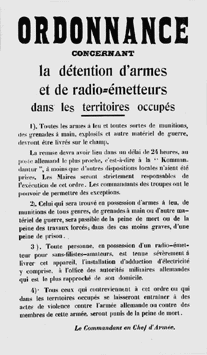
German poster from
occupied France imposing the death penalty for not turning in all firearms
and radio transmitters within 24 hours. For translation, see the text at
upper left. From the Musée de l'Ordre de la Libération, Paris. Photo by
Philippe Fraysseix, Paris.
Ordinance Concerning
the Possession of Arms and Radio Transmitters in the Occupied
Territories
1) All firearms and all
sorts of munitions, hand grenades, explosives and other war materials
must be surrendered immediately.
Delivery must take place within 24 hours to the closest Kommandantur
[German commander's office] unless other arrangements have been made.
Mayors will be held strictly responsible for the execution of this
order. The [German] troop commanders may allow exceptions.
2) Anyone found in possession of firearms, munitions, hand grenades or
other war materials will be sentenced to death or forced labor or in
lesser cases prison.
3) Anyone in possession of a radio or a radio transmitter must surrender
it to the closest German military authority.
4) All those who would disobey this order or would commit any act of
violence in the occupied lands against the German army or against any of
its troops will be condemned to death.
The Commander in Chief
of the Army
|
"Should you be so trusting
and turn over your weapons you will be put on a 'black list' in spite of
everything. The enemy will always need hostages or forced laborers later on
(read: 'work slaves') and will gladly make use of the 'black lists.' You see
once again that you cannot escape his net and had better die fighting. After the
deadline, raids coupled with house searches and street checks will be
conducted."7
Commented The New York Times
about the interrelated rights that the Nazis destroyed wherever they went:
"Military orders now
forbid the French to do things which the German people have not been allowed to
do since Hitler came to power. To own radio senders or to listen to foreign
broadcasts, to organize public meetings and distribute pamphlets, to disseminate
anti-German news in any form, to retain
possession of firearms--all these things are prohibited for the subjugated
people of France ."8
While the Nazis made good on
the threat to execute persons in possession of firearms, the gun control decree
was not entirely successful. Partisans launched armed attacks. But resistance
was hampered by the lack of civilian arms possession.
In 1941, U.S. Attorney General
Robert Jackson called on Congress to enact national registration of all
firearms.9 Given events in Europe, Congress
recoiled, and legislation was introduced to protect the Second Amendment. Rep.
Edwin Arthur Hall explained: "Before the advent of Hitler or Stalin, who
took power from the German and Russian people, measures were thrust upon the
free legislatures of those countries to deprive the people of the possession and
use of firearms, so that they could not resist the encroachments of such
diabolical and vitriolic state police organizations as the Gestapo, the OGPU,
and the Cheka."10
Rep. John W. Patman added:
"The people have a right to keep arms; therefore, if we should have some
Executive who attempted to set himself up as dictator or king, the people can
organize themselves together and, with the arms and ammunition they have, they
can properly protect themselves ."11
Only two months before the
Japanese sneak attack on Pearl Harbor, Congress enacted legislation to authorize
the President to requisition broad categories of property with military uses
from the private sector on payment of fair compensation, but also provided:
"Nothing contained in this
Act shall be construed?
"(1) to authorize the
requisitioning or require the registration of any firearms possessed by any
individual for his personal protection or sport (and the possession of which is
not prohibited or the registration of which is not required by existing law),
[or]
"(2) to impair or infringe
in any manner the right of any individual to keep and bear arms ."12
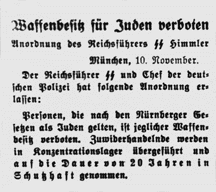
At the time of
the Nazi attack on Jews known as Night of the Broken Glass, Heinrich
Himmler, head of the Nazi SS and Police, ordered Jews disarmed.
People's Observer (Völkische Beobachter), November 10, 1938.
Jews Forbidden to
Possess Weapons
By Order of SS Reichsfuhrer Himmler
Munich, November 19
[1938]
The SS Reichsfuhrer and
German Police Chief has issued the following Order:
Persons who, according to the Nuremberg law, are regarded as Jews, are
forbidden to possess any weapon. Violators will be condemned to a
concentration camp and imprisoned for a period of up to 20 years. |
Meanwhile Hitler unleashed
killing squads called the Einsatzgruppen in Eastern Europe and Russia. As Raul
Hilberg observes, "The killers were well armed . The victims were
unarmed."13 The Einsatzgruppen executed 2
million people between fall 1939 and summer 1942. Their tasks included arrest of
the politically unreliable, confiscation of weapons and extermination.14
Typical executions were that of
a Jewish woman "for being found without a Jewish badge and for refusing to
move into the ghetto" and another woman "for sniping." Persons
found in possession of firearms were shot on the spot. Yet reports of sniping
and partisan activity increased.15
Armed citizens were hurting the
Nazis, who took the sternest measures. The Nazis imposed the death penalty on a
Pole or Jew: "If he is in unlawful possession of firearms, or if he has
credible information that a Pole or a Jew is in unlawful possession of such
objects, and fails to notify the authorities forthwith."16
Given the above facts, it is
not difficult to understand why the National Rifle Association opposed gun
registration at the time and still does. The American Rifleman for February 1942
reported:
"From Berlin on January
6th the German official radio broadcast?' The German military commander
for Belgium and Northern France announced yesterday that the population would be
given a last opportunity to surrender firearms without penalty up to January
20th and after that date anyone found in possession of arms would be executed.'
"So the Nazi invaders set
a deadline similar to that announced months ago in Czechoslovakia, in Poland, in
Norway, in Romania, in Yugoslavia, in Greece.
"How often have we read
the familiar dispatches 'Gestapo agents accompanied by Nazi troopers swooped
down on shops and homes and confiscated all privately owned firearms!'
"What an aid and comfort
to the invaders and to their Fifth Column cohorts have been the convenient
registration lists of privately owned firearms - lists readily available for the
copying or stealing at the Town Hall in most European cities.
"What a constant worry and
danger to the Hun and his Quislings have been the privately owned firearms in
the homes of those few citizens who have 'neglected' to register their
guns!"17
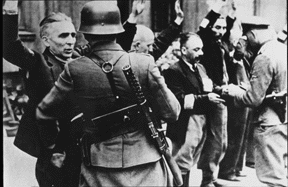
Resistance to Nazi
oppression was hampered by the lack of civilian arms possession. One of
the most notable exceptions was the Warsaw Ghetto Uprising in 1943,
which began with a few incredibly brave Jews armed with handguns. They
were able to temporarily stop deportations of Jews to Nazi extermination
camps.
During the war years the Rifleman
regularly included pleas for American sportsmen to "Send a gun to defend a
British home. British civilians, faced with the threat of invasion, desperately
need arms for the defense of their homes."18
Indeed, The New York Times carried the same solicitations. After two decades of
gun control, British citizens now desperately needed rifles and pistols in their
homes, and they received the gifts with great appreciation. Organized into the
Home Guard, armed citizens were now ready to resist the expected Nazi onslaught.
With so many men and guns sent
abroad to fight the war, America still needed defending from expected invasions
on the East and West coasts, domestic sabotage, and Fifth Column activity.
Sportsmen and gun clubs responded by bringing their private arms and
volunteering for the state protective forces.19
Switzerland was the only
country in Europe, indeed in the world, where every man had a military rifle in
his home. Nazi invasion plans acknowledged the dissuasive nature of this armed
populace, as I have detailed in my book Target Switzerland: Swiss Armed
Neutrality in World War II (Rockville Center, New York: Sarpedon Publishers,
1998).
Out of all the acts of armed
citizen resisters in the war, the Warsaw Ghetto Uprising of 1943 is difficult to
surpass in its heroism. Beginning with just a few handguns, armed Jews put a
temporary stop to the deportations to extermination camps, frightened the Nazis
out of the ghetto, stood off assaults for days on end, and escaped to the
forests to continue the struggle. What if there had been two, three, many Warsaw
Ghetto Uprisings?20
The NRA trained hundreds of
thousands of Americans in rifle marksmanship during World War II. President
Harry Truman wrote that NRA's firearms training programs "materially aided
our war effort" and that he hoped "the splendid program which the
National Rifle Association has followed during the past three-quarters of a
century will be continued."21 By helping
defeat the Nazi and Fascist terror regimes, the NRA helped end the Holocaust,
slave labor and the severest oppression.
Those tiny pacifist
organizations of the era that called for gun registration and confiscation
contributed nothing to winning the war or to stopping the genocide. Their
counterparts today have nothing to offer that would enable citizens to resist
genocide.
Individual criminals wreak
their carnage on individuals or small numbers of people. As this century has
shown, terrorist governments have the capacity to commit genocide against
millions of people, provided that the people are unarmed. Schemes to confiscate
firearms kept by peaceable citizens have historically been associated with some
of the world's most insidious tyrannies. Given this reality, it is not
surprising that law-abiding gun owners oppose being objects of registration.
Notes:
1. Interview with Bill Clinton, "Good Morning
America," June 4, 1999
2. The New York Times, Nov. 9, 1938, 24.
3. Gerald Schawb, The Day the Holocaust Began (New York: Praeger,
1990), 22.
4. The New York Times, Nov. 11, 1938, 1, 4.
5. The Holocaust, Vol. 3, The Crystal Night Pogrom, John
Mendelsohn, ed. (New York: Garland, 1982), 183-84.
6. Die Deutsche Wochenschau, No. 506, 15 May 1940, UfA, Ton-Woche.
7. Major H. Von Dach, Total Resistance (Boulder: Paladin Press,
1965), 169. Earlier published as Dach, Der Totale Widerstand (Biel: SUOV, 2nd
ed., 1958).
8. The New York Times, July 2, 1940, 20.
9. The New York Times, Jan. 4, 1941, 7.
10. 87 Congressional Record, 77th Cong., 1st Sess., 6778 (Aug.
5, 1941).
11. Id. At 7102 (Aug. 13, 1941).
12. Property Requisition Act, P.L. 274, 77th Cong., 1st Sess.,
Ch. 445, 55 Stat., pt. 1, 742 (oct. 16, 1941). See. Halbrook, "Congress
Interprets the Second Amendment," 62 Tennessee Law Review 597, 618-31
(Spring 1995).
13. Raul Hilberg, The Destruction of the European Jews (New
York: Homes and Meir, 1985), 341, 318, 297.
14. Yitzhak Arad et al. eds., The Einsatzgruppen Reports (New
York: Holocaust Library, 1989), ii.
15. Id. At 233, 306, 257-58, 352-53, 368.
16. Reichsgesetzblatt, I, 759 (4 Dec. 1941).
17. The Nazi Deadline, The American Rifleman, February1942, at
7.
18. The American Rifleman, Nov. 1940.
19. E.g., Report of the Adjutant General for 1945, at 23-24
(Richmond, Va., 1946); U.S. Home Defense Forces Study 58-59 (Office of Ass't.
Sec. Of Defense 1981).
20. See Rotem (Kazik), Simha, Memoirs of a Warsaw Ghetto
Fighter (New Haven: Yale University Press, 1994), 118-119; David I. Caplan,
"Weapons Control Laws: Gateways to Victim Oppression and Genocide," in
To Be a Victim: Encounters with Crime and Injustice, eds. Diane Sank and David
I. Caplan (New York: Plenum Press, 1991), 310.
21. Letter of Pres. Truman to C.B. Lister, NRA Sec.-Treas.,
Nov. 14, 1945.n
_______________________________________________
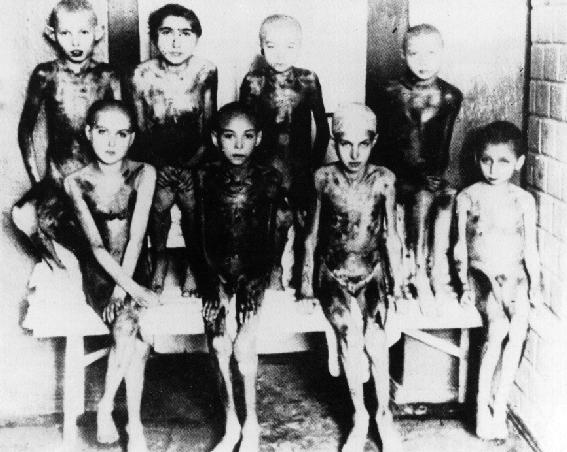
FOR THE SAKE OF OUR CHILDREN - NEVER
DISARM !
Children subjected to Government Medical experiments -
Auschwitz.
____________________________________________
TO MAIN PAGE
|