|
| |
Exclusive News Service

Worldwide Breaking News
Struggling Photographer Chooses Principle Over Money
By the Staff of Just Facts
9-22-00
In August of 1999, freelance photographer Michael Clancy captured a remarkable
image: The hand of a 21 week-old prenatal baby holding a surgeon's finger.
Clancy thought the photo might win a Pulitzer Prize. Instead, the picture has
generated a lot more controversy than awards.
| (Copyright: Michael Clancy. Used with the permission
of SABA Press, New York, N.Y.) |
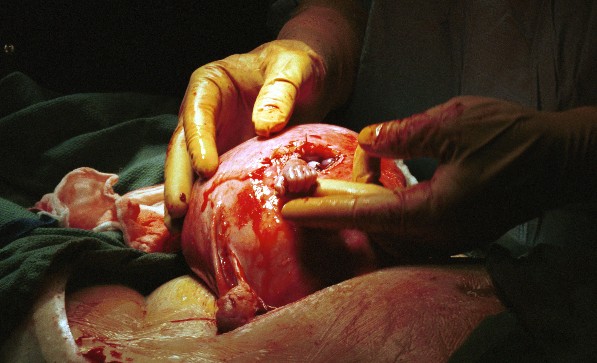 |
The hand of Samuel Armas outside of his mother's womb at 21 weeks
gestation. A full term
pregnancy is about 40 weeks. |
What Michael Clancy refers to as 'the experience of a lifetime', began last
summer when he received a phone call from USA Today. The national newspaper
asked him to photograph an innovative surgery being performed on prenatal
babies with spina bifida. Spina bifida is a condition where the baby's body
fails to properly enclose the spine during prenatal development. Doctors at
Vanderbilt University Medical Center have developed a corrective procedure
that begins with opening the mother's abdomen along the bikini line,
withdrawing the uterus, and placing it on top of her stomach. Operation on the
baby commences after the doctor cuts a hole in the uterus and drains the
amniotic fluid. The surgeon encloses the spine by stitching the skin around it
using sutures thinner than a human hair. The amniotic fluid is then returned
to the uterus and the womb is placed back in the mother's body.
Clancy accepted the assignment from USA Today, and a few days later found
himself in an operating room at Vanderbilt. The surgery lasted for an hour.
Clancy shot nine rolls of film, averaging one picture every 11 seconds. It was
near the end of the surgery when he captured this striking photo.
Excitedly, Clancy acquired the services of a photo agency to see if Life
magazine would like to publish his picture. The response he received shocked
and angered him. Clancy says that Life expressed an interest in buying his
picture, but only for the purpose of eliminating it. Life magazine is owned by
Time-Warner, a 27 billion dollar corporate conglomerate that owns an
assortment of high profile media and entertainment interests such as CNN, HBO,
Sports Illustrated, and Time. Michael Clancy's claim has been confirmed
independently by a source who wishes to remain anonymous.
"They want to buy it to kill it."
These are the words that Clancy said he heard from the photo agency that was
negotiating the sale of his picture to Life. Clancy had been struggling to
earn a living as a photographer for 13 years. He had earned $7,900 the
previous year and was deeply in debt. Although he needed the cash, his
immediate response was: "Bad choice of words. No way. Not for any
amount of money."
Aside from taking pride in his work and wanting it to be published, Clancy had
another reason for refusing to sell out his picture. He wanted the picture to
be seen by as many people as possible because it provided a miraculous glimpse
of life in a mother's womb. Prior to the photo shoot, Clancy considered a
fetus to be purely a part of a women's body, and felt that if she wanted an
abortion, it was nobody's business but her own. Clancy states that what he saw
that day in the operating room changed his opinion immediately.
The reasons behind Life's desire to kill Clancy's picture remain uncertain. A
short time before Clancy took his photo, a photographer on assignment for Life
took a similar picture. The key difference between the two photos is that
Clancy's was captured in the blink of an eye and the other picture was planned
out and posed for. Life published the picture taken on assignment for them in
the December 1999 issue of their magazine.
Clancy's picture first gained national prominence when cyber-reporter Matt
Drudge attempted to present it on his Fox News Channel TV show. Drudge had
planned to show the picture, talk about the surgery, and ask a rhetorical
question along the lines of, "If we are doing so much to save the life of
this baby, why are we deliberately killing others?" Fox News forbid
Drudge to show the picture, stating that the picture was of a spina bifida
surgery and could not be used in the abortion debate. Drudge stated that he
would not be censored and refused to do his show. Consequently, Fox cancelled
Drudge's show.
Life takes credit for Drudge dispute.
Life Magazine selected the photo
that they published as one of the top pictures of the year. In the caption
beneath it, Life asserts that the photo, "became the center of a
controversy when the Fox News cable channel canned talk-show host Matt
Drudge." Ironically, it was not the photo that Life published, but the
one taken by Michael Clancy that was at the center of the Drudge/Fox News
controversy.
The Columbia University Graduate School of Journalism administers a
prestigious award for magazine photography under a grant from LIFE magazine.
Columbia selected the picture that was published in Life as one of the top
photos of the year. Clancy's picture could not be entered as a candidate for
this award because it did not appear in an American magazine, which is a
requirement for eligibility. Newsweek purchased the rights to Clancy's picture
during late 1999, but they never published it.
Clancy's picture did win an award from the University of Missouri School of
Journalism. More important to Clancy than formal recognition is that the photo
receives exposure. He is optimistic that as medical science advances and
people are exposed to pictures such as his and the one that appeared in Life,
there will be a great reduction in the millions of abortions that are done
yearly.
Particularly disturbing to Clancy is the practice of partial birth abortion.
The partial birth abortion procedure involves forced delivery of the entire
baby except for his or her head. The back of their neck is then punctured and
the baby's brain is removed with a suction device. The majority of partial
birth abortions are performed on prenatal babies between 20 and 27 weeks
gestation. Samuel Armas was at 21 weeks gestation when Clancy photographed
him. In some cases, these abortions have been done later than 36 weeks.
Recently, the United States Supreme Court voted 5 against 4, striking down a
Nebraska law that prohibited partial birth abortions. Since the Supreme
Court's ruling was decided by a single vote, and the President appoints
Supreme Court nominees, abortion is expected to be an important issue during
the election battle between Al Gore and George W. Bush. Gore favors keeping
all abortions legal, including partial birth abortions. Bush opposes abortion
except in cases of rape, incest, and the when the life of the mother is in
danger. Al Gore has promised that his appointees to the Supreme Court would
very likely strike down any new laws restricting abortions. Bush has pledged
to sign a bill prohibiting partial birth abortions if Congress sends him one.
The issue of partial birth abortion also has implications for the upcoming
congressional elections. In 1998, Congress tried to pass a federal law
prohibiting partial birth abortions, but the legislation was vetoed by Bill
Clinton. The House of Representatives was successful in overriding Clinton,
but the Senate fell 3 votes short of the required 2/3 majority necessary to
override a presidential veto.
1998 Congressional Votes to Override Bill Clinton's Veto of
Partial Birth Abortion Ban
| |
Voted to make partial
birth abortion illegal |
Voted to keep partial birth
abortion legal |
| House: |
|
|
| Republicans |
96% |
4% |
| Democrats |
38% |
62% |
| Senate: |
|
|
| Republicans |
93% |
7% |
| Democrats |
29% |
71% |
Note- Samuel Alexander Armas was born without complication in December of
1999. According to a web site that contains a picture
of Samuel at ten weeks after birth and a letter from his Mom, Samuel's
"brain continues to appear normal on ultrasound", and "[t]hough
he has little movement of the feet and ankles, he is achieving all the
appropriate developmental milestones."
Medical Note - The rate of occurrence for spina bifida is considerably reduced
when mothers take a folic acid supplement during their first 6 weeks of
pregnancy.
________________________
Please e-mail your comments or questions to: 2ndamend@dnai.com.
TO MAIN PAGE
|